MLRun v1.8 Release: with Smarter Model Monitoring, Alerts and Tracking


Today we’re announcing MLRun 1.8, now available to the community. This latest version adds to the series of improvements to LLM monitoring released in 1.7, with in-platform alerts. Plus, several more improvements to help to track and evaluate models, and navigate the platform with ease.
Read all the details below:
MLRun v1.7 introduced a flexible monitoring infrastructure, the ability to monitor unstructured data, metrics customization, and more.
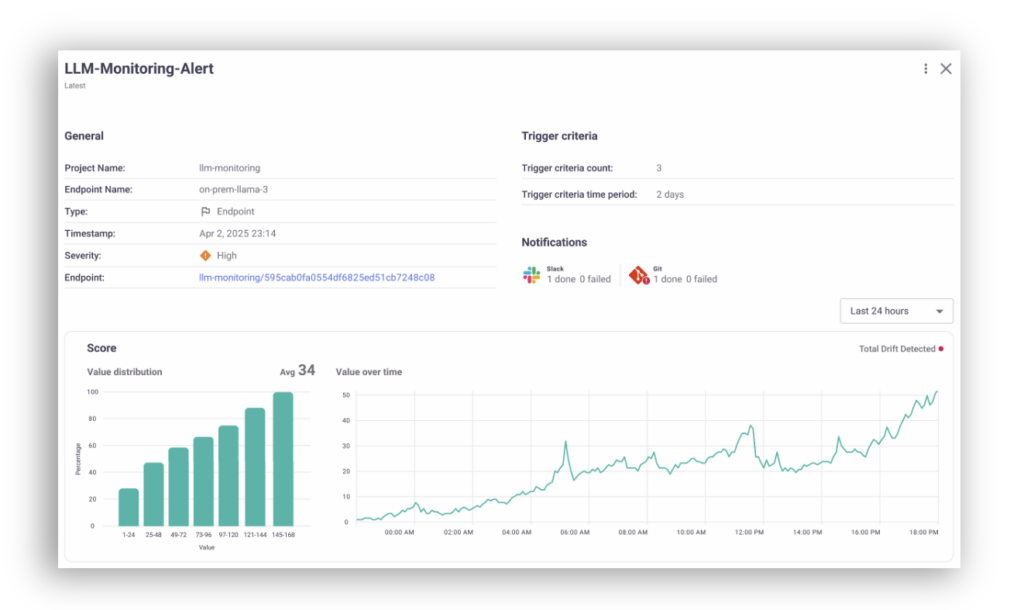
MLRun v1.8 builds on these capabilities and now includes monitoring alerts built into the MLRun UI.
Users can set up alerts on criteria such as:
Once alerted, users can click through to the flagged issues and investigate directly in MLRun, without having to context switch to external monitoring systems.
Experiment tracking is used to measure metrics, compare results, reproduce experiments and optimize models. This is a core MLRun capability.
Now, MLRun v1.8 supports experiment tracking for document-based models, like LLMs. This is enabled through the LangChain API, which is integrated into vector databases.
Users can track their documents as artifacts, with metadata like:
Debugging LLMs is a complicated process. It requires: 1) Deployment 2) Realizing there’s an issue 3) Identifying the root cause 4) Analysis and evaluation 5) Fixing 6) Redeploying. This process is long, technologically complex and resource-intensive. It’s also prone to potential errors.
In MLRun v.1.8, this process is shorter and more resource-efficient. Users can now monitor and evaluate models before deploying them. MLRun runs the model, returning performance results without consuming unnecessary compute resources.
Managing large-scale projects across teams requires a reliable and user-friendly system.
Following user requests, MLRun v1.8 includes pagination, to enhance responsiveness and reduce scrolling and performance bottlenecks arising from long page loading times.
What’s your feedback on MLRun 1.8? Join the community and share your insights and requirements for future releases.
Explore MLRun 1.8.

As organizations transition from experimenting with LLMs to deploying gen AI applications and driving business value, data professionals face operationalization challenges. These include hallucinations, bias, model misuse, PII leakage, harmful content, inaccuracy, and more. Detecting and addressing these issues requires robust monitoring solutions in the AI pipeline.
By ensuring monitoring is part of AI pipeline orchestration, data professionals can implement a continuous feedback loop. The monitoring results can be used to fine-tune models, ensuring they are high-performing, reliable and accurate. This ensures risks are mitigated before reaching production, allowing for the integrity and operational stability of gen AI applications.
MLRun can integrate with any monitoring application, regardless of its ecosystem. This means users can use MLRun to orchestrate their gen AI application, including tasks like data preparation, model tuning, customization, validation and model optimization. Then, they can view monitoring results either in MLRun or their monitoring application of choice, and feed the results back to the AI pipeline.
Integrating MLRun with an external monitoring application is simple and straightforward. Here’s how it works:
Integrating with your monitoring application takes place through their SDK or API. Explore and identify your application’s SDK or find the API endpoints, request payloads and response structure in the documentation.
In MLRun, implement a Python class that inherits from MLRun’s ModelMonitoringApplication base class.
This class must include the do_tracking method, which defines the logic for interacting with the external application through the API or SDK.
The do_tracking method returns a list of key-value metrics and outcomes, including details like detected drift or model performance metrics. This abstraction ensures compatibility with any monitoring application.
After defining the Python class, register it as a monitoring function in MLRun. Use the set_model_monitoring_function method to add the function to your MLRun project and deploy it.
Once deployed, the monitoring application integrates seamlessly into the MLRun workflow.
You can see an example of how this works with open-source Evidently right here.
MLRun offers several key advantages for integrating external monitoring applications:
Model monitoring is foundational for maintaining reliable gen AI applications. MLRun simplifies the process by offering a generic, modular approach to integrating external monitoring applications. Whether your organization uses a market-leading tool or a custom-built solution, MLRun can fit seamlessly into your monitoring strategy.

As the open-source maintainers of MLRun, we’re proud to announce the release of MLRun v1.7. MLRun is an open-source AI orchestration tool that accelerates the deployment of gen AI applications, with features such as LLM monitoring, data management, guardrails and more. We provide ready-made scenarios that can be easily implemented by teams in organizations. This new release is packed with powerful features designed to make gen AI deployments more flexible and faster than ever before.
Specifically, V1.7 brings significant LLM monitoring enhancements, helping users ensure the integrity and operational stability of LLMs in production environments. Additional updates introduce performance optimizations, multi-project management, and more.
Read all the details below:
MLRun 1.7 introduces a new, flexible monitoring infrastructure that enables seamless integration of external tools and applications into AI pipelines, using APIs and pre-built integration points. This includes tools for external logging, alerting, metrics systems, etc.
For instance, users can now:
Given that LLMs primarily handle unstructured data, one of the key advances in MLRun 1.7 is its enhanced ability to enable tracking this kind of data with more precision.
A common way to monitor LLMs is to create another model that would act as a judge. See a demo of how this works.
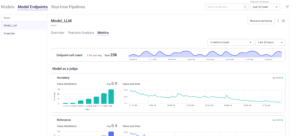
MLRun 1.7 introduces a new endpoint metrics UI. Its expanded endpoint monitoring capabilities allow users to:
For example, a time-series chart could indicate a bottleneck in the inference pipeline or model scaling issues.
The ability to track, visualize, and analyze endpoint performance enables teams to adjust operational parameters or retrain models as soon as performance starts to degrade. This reduces downtime or adverse effects in production environments.
With these capabilities, users can now customize their monitoring stacks per their business and tech stack requirements. Future releases will continue to enhance these capabilities, with more features and integrations for monitoring. This will allow for even greater flexibility and user control. So please share your feedback, so we can extend them based on your needs.
See a gen AI banking chatbot that uses MLRun’s new monitoring capabilities for fine-tuning, ensuring it only answers banking-related questions. This helps address the risks associated with gen AI, like hallucinations, inaccuracies, bias, harmful content, and more.
Version 1.7 simplifies the process of deploying Docker images, making it easier for users to run applications and models. Previously, deploying applications or models via Docker required manual configuration, with open-source Nuclio, and integration steps. Now, users can simply provide a Docker image and deploy it with minimal setup.
This improvement opens up development workflow possibilities. For example, users can more easily integrate custom UIs or dashboards that can interact with deployed models, allowing for more advanced and customized monitoring capabilities.
For enterprises working on multiple projects across diverse teams, keeping track of workflows and active jobs can become overwhelming. MLRun 1.7 introduces a cross-project view that consolidates all activities across projects into a single, centralized dashboard.
The cross-project view provides real-time visibility into all active jobs, workflows, and ML models across different projects. Users can:
This is especially valuable for organizations with complex environments where multiple teams may be working on different but interrelated projects.
Finally, MLRun 1.7 introduces improvements based on the invaluable feedback from you, our community users. We listened to the requirements and are releasing features that provide value in areas the community cares about most. This version introduces improved UI responsiveness, more efficient handling of large datasets, and a host of usability fixes. We look forward to your continued feedback on this version and the upcoming ones as well.
We’re looking forward to hearing your feedback about MLRun 1.7 and your future needs for the upcoming versions. Join the community and share your insights and requirements.